pvlib.irradiance.get_extra_radiation#
- pvlib.irradiance.get_extra_radiation(datetime_or_doy, solar_constant=1366.1, method='spencer', epoch_year=2014, **kwargs)[source]#
Determine extraterrestrial radiation from day of year.
- Parameters
datetime_or_doy (numeric, array, date, datetime, Timestamp, DatetimeIndex) – Day of year, array of days of year, or datetime-like object
solar_constant (float, default 1366.1) – The solar constant.
method (string, default 'spencer') – The method by which the ET radiation should be calculated. Options include
'pyephem', 'spencer', 'asce', 'nrel'.epoch_year (int, default 2014) – The year in which a day of year input will be calculated. Only applies to day of year input used with the pyephem or nrel methods.
kwargs – Passed to solarposition.nrel_earthsun_distance
- Returns
dni_extra (float, array, or Series) – The extraterrestrial radiation present in watts per square meter on a surface which is normal to the sun. Pandas Timestamp and DatetimeIndex inputs will yield a Pandas TimeSeries. All other inputs will yield a float or an array of floats.
References
- 1
M. Reno, C. Hansen, and J. Stein, “Global Horizontal Irradiance Clear Sky Models: Implementation and Analysis”, Sandia National Laboratories, SAND2012-2389, 2012.
- 2
http://solardata.uoregon.edu/SolarRadiationBasics.html, Eqs. SR1 and SR2
- 3
Partridge, G. W. and Platt, C. M. R. 1976. Radiative Processes in Meteorology and Climatology.
- 4
Duffie, J. A. and Beckman, W. A. 1991. Solar Engineering of Thermal Processes, 2nd edn. J. Wiley and Sons, New York.
- 5
ASCE, 2005. The ASCE Standardized Reference Evapotranspiration Equation, Environmental and Water Resources Institute of the American Civil Engineers, Ed. R. G. Allen et al.
Examples using pvlib.irradiance.get_extra_radiation#
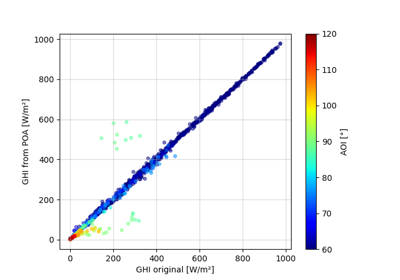
Reverse transposition using one year of hourly data
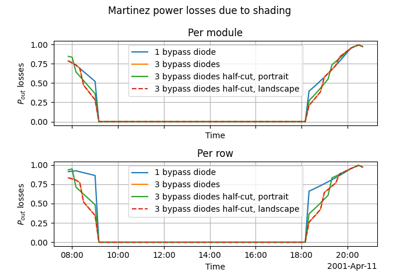
Modelling shading losses in modules with bypass diodes
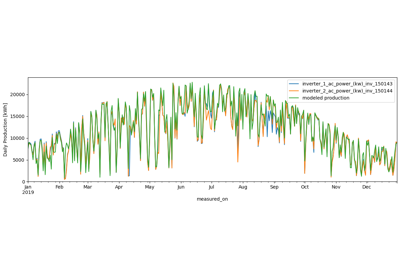
4.7 MW CdTe single-axis tracking (OEDI System 9068)