
pvlib.location.Location#
- class pvlib.location.Location(latitude, longitude, tz='UTC', altitude=None, name=None)[source]#
Location objects are convenient containers for latitude, longitude, timezone, and altitude data associated with a particular geographic location. You can also assign a name to a location object.
Location objects have two timezone attributes:
tzis a IANA timezone string.pytzis a pytz timezone object.
Location objects support the print method.
- Parameters:
latitude (float.) – Positive is north of the equator. Use decimal degrees notation.
longitude (float.) – Positive is east of the prime meridian. Use decimal degrees notation.
tz (str, int, float, or pytz.timezone, default 'UTC'.) – See http://en.wikipedia.org/wiki/List_of_tz_database_time_zones for a list of valid time zones. pytz.timezone objects will be converted to strings. ints and floats must be in hours from UTC.
altitude (float, optional) – Altitude from sea level in meters. If not specified, the altitude will be fetched from
pvlib.location.lookup_altitude(). If no data is available for the location, the altitude is set to 0.name (string, optional) – Sets the name attribute of the Location object.
See also
Methods
__init__(latitude, longitude[, tz, ...])from_epw(metadata[, data])Create a Location object based on a metadata dictionary from epw data readers.
from_tmy(tmy_metadata[, tmy_data])Create an object based on a metadata dictionary from tmy2 or tmy3 data readers.
get_airmass([times, solar_position, model])Calculate the relative and absolute airmass.
get_clearsky(times[, model, solar_position, ...])Calculate the clear sky estimates of GHI, DNI, and/or DHI at this location.
get_solarposition(times[, pressure, temperature])Uses the
pvlib.solarposition.get_solarposition()function to calculate the solar zenith, azimuth, etc.get_sun_rise_set_transit(times[, method])Calculate sunrise, sunset and transit times.
Examples using pvlib.location.Location#
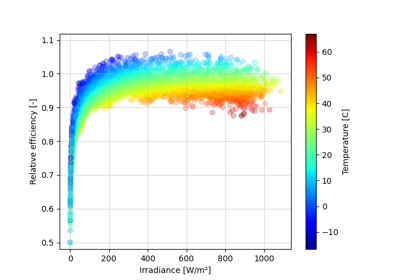
Simulating PV system DC output using the ADR module efficiency model
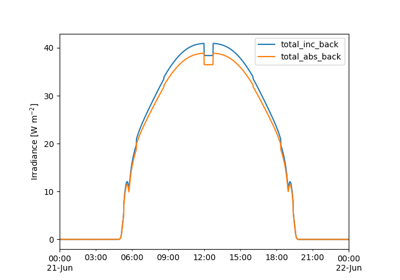


Reverse transposition using one year of hourly data


Use different Perez coefficients with the ModelChain


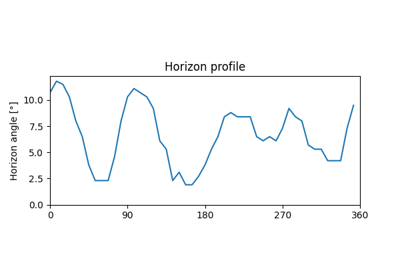

Modelling shading losses in modules with bypass diodes


4.7 MW CdTe single-axis tracking (OEDI System 9068)