
pvlib.irradiance.get_extra_radiation#
- pvlib.irradiance.get_extra_radiation(datetime_or_doy, solar_constant=1366.1, method='spencer', epoch_year=2014, **kwargs)[source]#
Determine extraterrestrial radiation from day of year.
- Parameters:
datetime_or_doy (numeric, array, date, datetime, Timestamp, DatetimeIndex) – Day of year, array of days of year, or datetime-like object
solar_constant (float, default 1366.1) – The solar constant.
method (string, default 'spencer') – The method by which the ET radiation should be calculated. Options include
'pyephem', 'spencer', 'asce', 'nrel'.epoch_year (int, default 2014) – The year in which a day of year input will be calculated. Only applies to day of year input used with the pyephem or nrel methods.
kwargs – Passed to solarposition.nrel_earthsun_distance
- Returns:
dni_extra (float, array, or Series) – The extraterrestrial radiation present in watts per square meter on a surface which is normal to the sun. Pandas Timestamp and DatetimeIndex inputs will yield a Pandas TimeSeries. All other inputs will yield a float or an array of floats.
References
Examples using pvlib.irradiance.get_extra_radiation#
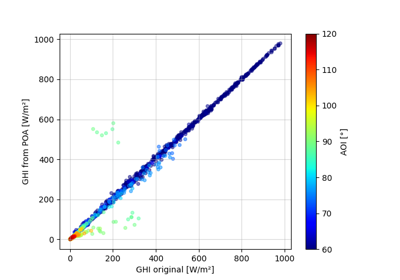
Reverse transposition using one year of hourly data
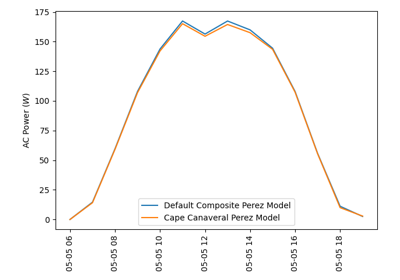
Use different Perez coefficients with the ModelChain
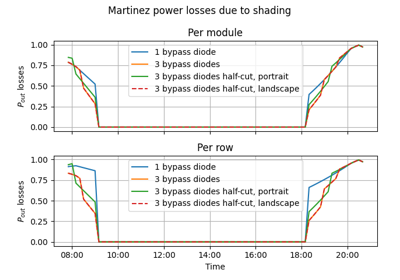
Modelling shading losses in modules with bypass diodes
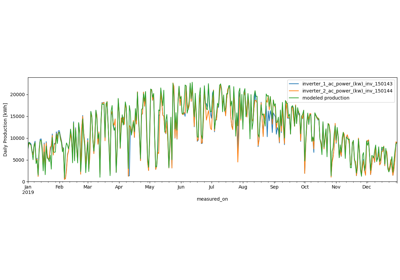
4.7 MW CdTe single-axis tracking (OEDI System 9068)